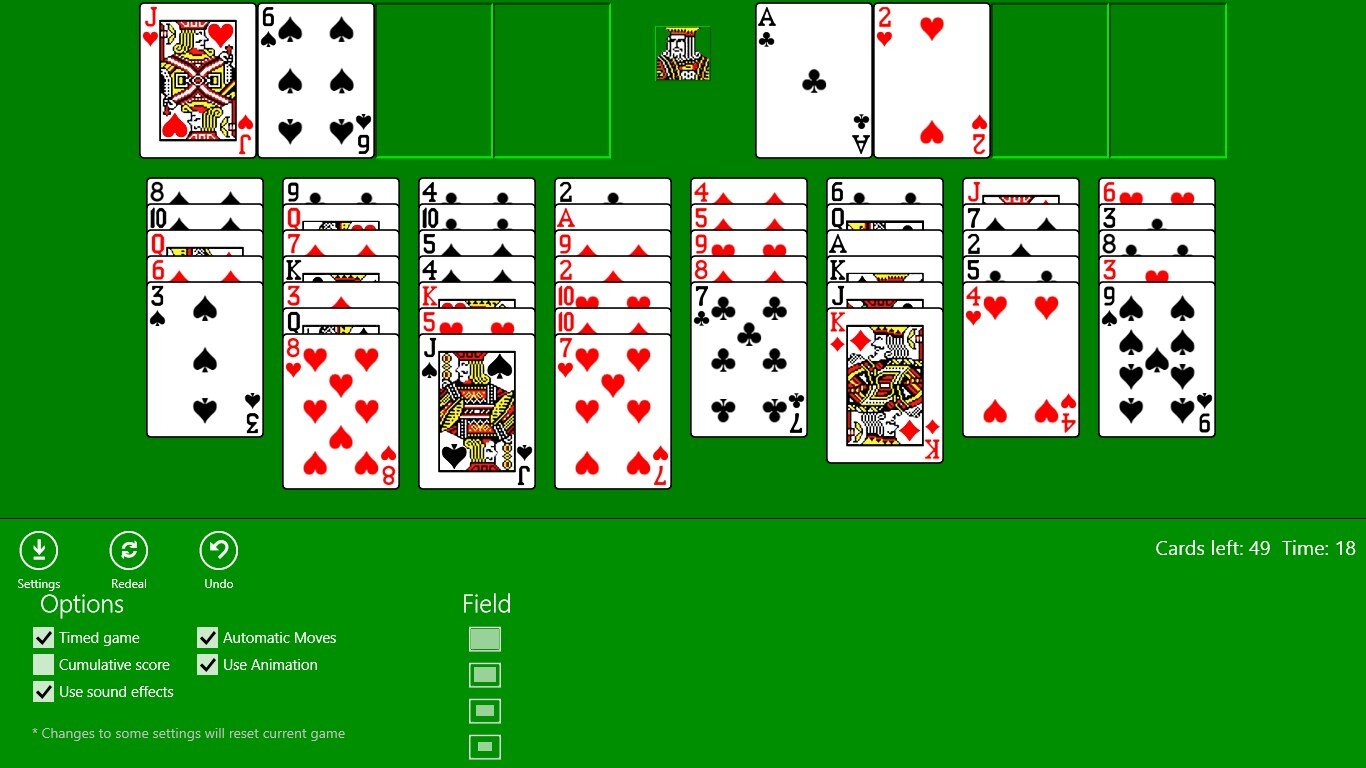
For most of the 1990s and 2000s, FreeCell lived in the Games folder on every Windows machine in the world. Minesweeper had its reputation, Pinball had its noise, but FreeCell had a particular grip on people who found it. A generation of office workers and students played it in the gaps between tasks, on lunch breaks, during slow calls. Then Windows 8 arrived in 2012 and that quiet executable stopped being part of a fresh install. Most people who noticed probably assumed it would be back.
How It Got There
FreeCell predates Windows by some margin. Paul Alfille is widely credited with writing a computerised version in 1978, and the variant most people know arrived in the Microsoft Entertainment Pack before shipping as a standard component of Windows 95. From that point on it was simply there — no download required, no account, no setup. You opened the Start menu, found the Games folder, and it launched in under a second.
For players who found Klondike too dependent on the draw order, FreeCell offered something different. All 52 cards are dealt face-up. The game becomes less about managing uncertainty and more about finding a path through a defined problem, which suited a different temperament. Some people who never clicked with Klondike played FreeCell daily for years.
Windows 8 and the Quiet Removal
Microsoft replaced the individual bundled games with the Microsoft Solitaire Collection, a unified Store app. FreeCell is still in there, but the context changed: the app is free-to-play, which means ads between hands, daily-challenge streaks, and progression mechanics layered over the rules. None of that is unusual for mobile-era card games. It just has nothing to do with what people remember.
The original freecell.exe was around 140 kilobytes. A status bar, a menu, a green felt background. The replacement is a different product in structure and intent, even if the underlying rules are the same.
The XP Binary and Its Complications
A meaningful number of long-time players still want the original, and forum threads on the subject span years. The common approach is to extract freecell.exe from a Windows XP installation — an old machine or an ISO — and run it on Windows 10 or 11. The executable itself usually launches.
The catch is cards.dll. The original card-art rendering depends on a shared library that Windows 10 and 11 either ship in a different form or not at all. The game falls back to placeholder graphics, renders cards incorrectly, or refuses to start. The workaround — copy the matching cards.dll from an XP source, place it next to the executable, hope SmartScreen does not flag it — works often enough that people keep recommending it. It is also several steps of effort for something that used to require none. Most people who run into trouble once do not try again.
The Current Landscape
Alternatives exist, and the range is wide. Some implementations are minimal and honest about what they are. Others arrive with account-creation prompts, animation on every move, and monetisation at enough points that the game starts to feel incidental. We build toward the first end of that range, and FreeCell is part of what this site covers — worth mentioning not as a pitch but as context: a no-setup version is available if you want to try the game without committing to an app. Finding the light end of the market in general does require some searching.
What the Game Actually Feels Like
FreeCell is harder than Klondike in a specific way. The four free cells look generous at first. In practice they fill faster than expected, and a tableau that seemed manageable two moves ago can lock. The discipline is knowing when not to use a free cell — every card parked there is one fewer degree of freedom for the rest of the hand.
The theoretical winnability rate for randomly dealt FreeCell games is above 99 percent. The one famous exception in the original Microsoft numbering is deal #11982, which is genuinely unsolvable and became a minor landmark in the game's community — people proved it computationally, argued about it in forums, and treated it as a shared reference point. Losing any other hand means you made a mistake somewhere, which produces a different feeling than losing at Klondike. There is no draw order to blame. You either found the path or you did not.
The shared game-number system is one of the stranger social artefacts of the era. The original Microsoft FreeCell used a deterministic shuffle keyed to a 32-bit integer, so game #617 deals identically on every copy of the software that follows the same convention. Two people could play the same hand on separate machines and compare solutions — an oddly social experience for a single-player desktop game. Most implementations have preserved that numbering out of respect for the old community, which means a deal discussed on a forum in 2003 is usually still reachable today.
Why It Holds Up
FreeCell did not need the things that were added to it. The original appeal was a solvable puzzle dealt fresh in a second, with nothing else attached. Playing it now — in whatever form you find — still delivers the same thing it delivered in 1995. The game is a search problem with a clean solution space, and for a lot of people that has always been enough.